
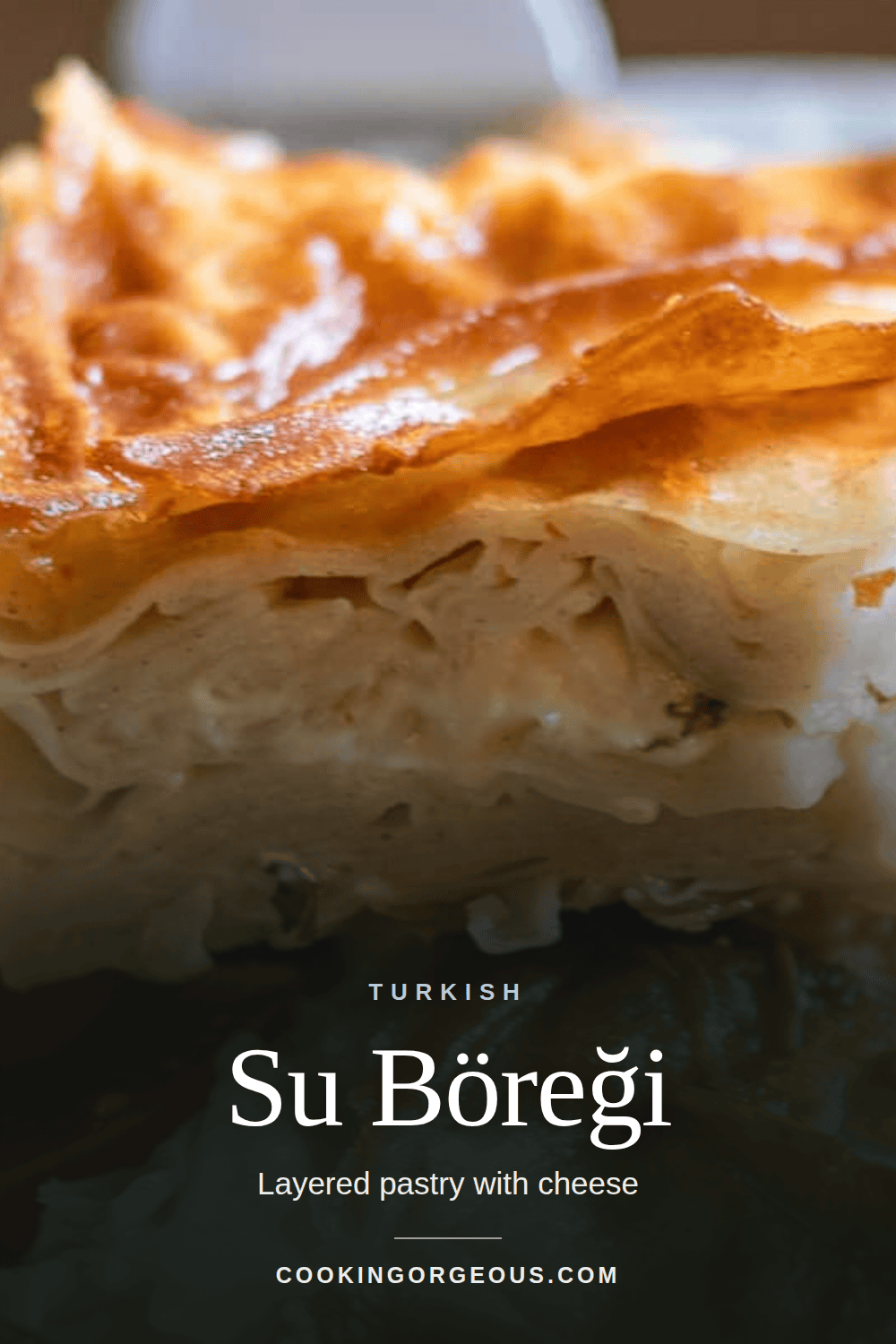
Su Boregi, or Water Borek, is a layered Turkish pastry made with a creamy feta and parsley filling. It has a reputation for being the trickiest borek to make, and it took me a few tries to get it right. This version breaks it down step by step, with a video to walk you through it, so you don't have to guess.

It is perfect for breakfast, lunch, dinner, or as a snack any time of the day.
Once you get the rhythm down, each stage moves quickly, and you'll end up with a golden, layered borek that's worth the effort.
Jump to:

Why This Recipe Works?
- Every step is covered with clear photos and a full video tutorial, so you can make this Su Boregi confidently on your own, no extra hands needed.
- It freezes beautifully. Assemble a batch ahead of time and keep it in the freezer for up to five months for an easy make-ahead meal.
- Want a meat-filled version? Try my Kiymali Borek (Meat Borek) for a heartier take.
- This recipe makes about 22 pieces, plenty to feed a crowd or freeze for later.
Ingredients You'll Need
Please scroll down to the recipe card below for the full ingredients list with measurements, complete recipe method, recipe notes, and nutritional information.

- Strong white flour - It is also known as strong bread flour. It is made from hard wheat varieties and contains more gluten than other types of flour. It gives the dough some elasticity, which makes it easier to roll out. Adjust the amount of flour until you reach a smooth but firm texture, like pasta dough.
- Eggs - I used 6 large eggs for this recipe. The size of the eggs will affect the amount of flour you use.
- Feta cheese - I prefer feta cheese made with sheep milk with high-fat content and a creamy texture.
- Butter - Use salted or unsalted. It adds great flavor and crispness to borek. Replace it with olive oil or vegetable oil if you prefer.
How to Make Su Boregi
Prepare the Filling
Crumble the feta cheese in a medium-sized bowl. Finely chop the parsley and add it to the cheese. Gently combine the cheese and parsley, and set them aside. In a separate bowl, mix the melted butter with ¼ cup of oil and set them aside.

Prepare the Dough
Place 2 tablespoon of vegetable oil, salt, and eggs in a large bowl and whisk until all is mixed. Add the flour gradually to the egg mixture and combine until it forms a dough. The amount of flour depends on the size of the eggs.
Knead the dough to form a smooth but firm dough using your hands or a stand mixer.

Divide the dough into 10 equal pieces and turn them into balls. Cover the balls with a damp cloth or cling film and let them rest for 15 to 20 minutes.

Roll Out the Yufka Sheets
Turn one of the small dough balls onto a lightly floured surface and roll it out into the size of a small plate, the size of 5" (12 cm). Sprinkle it with a generous amount of flour and set it aside.
Take another small dough ball and roll it out the same size as the first one. Place it on top of the first dough ball and sprinkle on some more flour.

Repeat until you have 3 dough balls rolled out and put them on top of each other, making sure there is plenty of flour in between them. Build another group of 3 dough balls and 4 dough balls the same way, and let them rest for 10 minutes.
You should have three groups of pastries made with three+three+four balls (10 in total).

Generously flour your kitchen top and start rolling out the pastry groups into larger-sized pastries, a size of 10" (25 cm). Make sure there is enough flour between the layers to avoid the pastries sticking to each other while rolling them out.

Let them rest for another 10 minutes before the last stage of rolling the pastries into yufka. Place a large pan filled with water on medium-high heat, and then add 1 tablespoon of salt and 1 tablespoon of oil. Bring the pan to a boil while finishing the yufka sheets.

For the final stage of rolling out the yufka sheets, dust your kitchen top with some flour. You will need a long rolling pin called "oklava" at that stage.
Place one of the pastries on your kitchen top and roll it out to the size of your baking pan, 14" (35cm) dia. Use a generous amount of flour to avoid it sticking. Fold it and set it aside. Cover it with a clean cloth and repeat the same for the remaining 9 pastries.

Blanch the Yufka Sheets
Prepare an ice-water bath in a large bowl and place it next to the boiling water. Spare two yufka sheets aside and then start blanching the remaining 8 yufka.
Pick one of the yufka, dust off the extra flour, gently lower it into boiling water, and press to submerge. Depending on the size of your pan, you can blanch two or three yufka sheets at the same time.

Simmer them for 30 to 40 seconds, remove them carefully using a sieve or a slotted spoon, and drop them into the ice-cold water.
You might need to change the ice-cold water a few times during the process to make sure you have very cold water for each piece of yufka sheets.

When the yufka sheets are cooled down, lift them with your hands, and lay them onto the strainer to get rid of the water. When you have 4 yufka sheets blanched and cooled down, start building the borek.
Build the Borek
Brush your baking tray with a generous amount of melted butter. Place one of the "uncooked" yufka sheets on the tray and brush it with melted butter.

On top of the uncooked yufka, place one of the blanched yufka carefully. The blanched yufka will be much larger, so you will need to shrink it to the size of the pan. Brush it with a generous amount of butter.

Repeat the same with the remaining three blanched yufka sheets and spread the cheese filling evenly.

Preheat your oven to 360° F (180° C) before proceeding to blanch the rest of the sheets. Blanch, cool down, and drain the rest of the 4 yufka sheets the same way to finish building the borek.
Layer the 4 blanched yufka sheets on top of the filling, brushing generously in between the sheets. Place the second "uncooked" yufka sheet that you spared on top and brush it with the remaining melted butter-oil mixture.

Cook the borek for 45 to 50 minutes, until the bottom and the top, are both nicely browned and crispy. Let it rest for 15 minutes before portioning and serving.

Recipe Tips From the Chef
- Dough consistency is the key to this recipe. Treat the amount of flour in the recipe card as a starting point, and add more as needed until the dough feels smooth and firm, about the same as a good pasta dough.
- Keep the dough balls covered with a damp cloth or cling film while you work through the rest. They dry out fast once exposed to air and get harder to roll.
- Dust plenty of flour between the rolled-out yufka sheets so they don't stick together while you're working through them.
- Dust off any extra flour from the yufka before lowering it into the boiling water. Leftover flour clouds the water and can leave the sheets gummy.
- Blanch each yufka for just 30 to 40 seconds. Any longer and the sheets get too soft to handle.
- Change your ice water a few times as you go. Each yufka needs to go into truly cold water, and it warms up fast.
- Spread the filling in a thin, even layer across the yufka sheet. It bakes through more evenly and is less likely to leak out from between the layers.
- Brush a generous, even layer of the melted butter and oil mixture between every sheet. This is what gives Su Boregi its rich flavor and crisp, golden layers.
Serving Suggestions
Su Boregi is traditionally served warm, cut into squares or triangles, alongside a cup of Turkish tea or a cold glass of Ayran, a salty Turkish yogurt drink. It also holds up well at room temperature, so it works for a buffet table or when you're serving a crowd.
It pairs well with a light salad to balance out the richness. Try it with Çoban Salatası, Gavurdagi Salatasi (Turkish Tomato Walnut Salad), or Greek Cucumber Salad. For a full spread, add it to a Turkish breakfast table with olives, cheese, and fresh vegetables.
How to store leftover su boregi
Once baked, Su Boregi keeps well in the fridge. Store leftovers in an airtight container for up to a week, and reheat in the oven to bring back the crisp top. You can also freeze it, either baked or unbaked, for up to five months. Thaw in the fridge overnight before reheating or baking.
Recipe FAQs
Yes, you can prepare it up to 3 days in advance and keep it refrigerated until you want to bake it.
I wouldn't recommend it. Phyllo is much thinner and more delicate than yufka dough, so it tends to fall apart once it hits the boiling water in the blanching step. Homemade yufka holds its shape and gives Su Boregi its signature soft, chewy texture.
Su means "water" in Turkish. The name comes from the way the yufka sheets are boiled, or blanched, in water before they're layered and baked, which is what gives this borek its soft, tender texture compared to other boreks.
Feta is traditional and gives the best briny flavor, but you can swap in a mix of ricotta and mozzarella, or a Turkish white cheese like beyaz peynir, if that's easier to find.
Related Recipes
For more delicious homemade Turkish Pastries why not try:


Did you make this recipe? Please let me know how it turned out! Leave a comment below and tag @cookingorgeous on Instagram and hashtag it #cookingorgeous.
I hope you enjoy the process of making this delicious Su Boregi - Water Borek as much as you enjoy eating it! 🙂
Want to Save This Recipe?
Enter your email & I'll send it to your inbox. Plus, get great new recipes from me every week!
By submitting this form, you consent to receive emails from Cooking Gorgeous

Su Boregi - Water Borek
Ingredients
For the Filling
- 2 cups crumbled feta cheese (500 grams)
- ½ cup parsley (chopped)
For the Layers
- 1 cup melted butter (200 grams)
- ¼ cup vegetable or sunflower oil
For the Pastry
- 6 large eggs
- 1 ½ teaspoon salt
- 2 tablespoon vegetable or sunflower oil
- 3 ¾ cups strong white flour for the dough (450 grams)
- ⅓ cup strong white flour for rolling out the pastries (50 grams)
For Cooking the Pastries
- 1 large pot of water
- 1 tablespoon salt
- 1 tablespoon vegetable or sunflower oil
Instructions
Prepare the Filling
- Crumble the feta cheese in a medium-sized bowl.
- Finely chop the parsley and add it to the cheese.
- Gently combine the cheese and parsley, and set them aside.
- In a separate bowl, mix the melted butter with ¼ cup of oil and set them aside.
Prepare the Dough
- Place 2 tablespoon of vegetable oil, salt, and eggs in a large bowl and whisk until all is mixed.
- Add the flour gradually to the egg mixture and combine until it forms a dough. The amount of flour depends on the size of the eggs.
- Knead the dough to form a smooth but firm dough using your hands or a stand mixer.
- Divide the dough into 10 equal pieces and turn them into balls.
- Cover the balls with a damp cloth or cling film and let them rest for 15 to 20 minutes.
Roll out the Yufka
- Turn one of the small dough balls onto a lightly floured surface and roll it out into a size of small plate, the size of 12 cm (5"). Sprinkle it with a generous amount of flour and set it aside.
- Take another small dough ball and roll it out the same size as the first one. Place it on top of the first dough ball and sprinkle on some more flour.
- Repeat until you have 3 dough balls rolled out and put them on top of each other, making sure there is plenty of flour in between them.
- Build another group of 3 dough balls and 4 dough balls the same way, and let them rest for 10 minutes. You should have three groups of pastries made with three +three+four balls (10 in total).
- Generously flour your kitchen top and start rolling out the pastry groups into larger sizes pastries, size of 25 cm (10"). Make sure there is enough flour between the layers to avoid the pastries sticking to each other while rolling them out.
- Let them rest for another 10 minutes before the last stage of rolling the pastries into yufka.
- Place a large pan filled with water on medium-high heat and add 1 tablespoon of salt and 1 tablespoon of oil.
- Bring the pan to a boil while finishing the yufka sheets.
- For the final stage of rolling out the yufka sheets, generously flour your kitchen top. You will need a long rolling pin called "oklava" at that stage.
- Place one of the pastries on your kitchen top and roll it out to the size of your baking pan, 35 cm (14") dia. Use a generous amount of flour to avoid it sticking. Fold it into four and set it aside. Cover it with a clean cloth and repeat the same for the remaining 9 pastries.
Blanch the Yufka Sheets
- Prepare an ice-water bath in a large bowl and place it next to the boiling water.
- Spare two yufka sheets aside and start blanching the remaining 8 yufka.
- Pick one of the yufka, dust off the extra flour, gently lower it into boiling water, and press to submerge. Depending on the size of your pan, you can blanch two or three yufka sheets at the same time.
- Simmer them for 30 to 40 seconds, remove them carefully using a sieve or a slotted spoon and drop them into the ice-cold water. You might need to change the ice-cold water a few times during the process to make sure you have very cold water for each piece of yufka sheets.
- When the yufka sheets are cooled down, lift them with your hands, and lay them onto the strainer to get rid of the water.
- When you have 4 yufka sheets blanched and cooled down, start building the borek.
Build the Borek
- Brush your baking tray with a generous amount of melted butter.
- Place one of the "uncooked" yufka sheets on the tray and brush it with melted butter.
- On top of the uncooked yufka, place one of the blanched yufka carefully. The blanched yufka will be much larger so you will need to shrink it to the size of the pan. Brush it with a generous amount of butter.
- Repeat the same with the remaining three blanched yufka sheets and spread on the cheese filling evenly.
- Preheat your oven to 180° C (360° F) before proceeding to blanch the rest of the sheets.
- Blanch, cool down, and drain the rest of 4 yufka sheets the same way to finish building the borek.
- Layer the 4 blanched yufka sheets on top of the filling, brushing generously in between the sheets.
- Place the second "uncooked" yufka sheet that you spared on the top and brush it with the remaining melted butter-oil mixture.
- Cook the borek for 45 to 50 minutes, until the bottom and the top, are both nicely browned and crispy.
- Let it rest for 15 minutes before portioning and serving.
Video
Notes
- Dough should be smooth and firm, about the same as a good pasta dough. Use the flour amount in the recipe card as a starting point and add more as needed. Keep the dough balls covered with a damp cloth while they rest so they don't dry out.
- Dust plenty of flour between the rolled-out yufka sheets so they don't stick together.
- Dust off any extra flour before blanching, and blanch each yufka for just 30 to 40 seconds so the sheets don't get too soft.
- Change your ice water a few times as you go. Each yufka needs a truly cold soak.
- Brush a generous, even layer of the butter and oil mixture between every sheet. This is what gives Su Boregi its rich flavor and crisp, golden layers.
- Spread the filling in a thin, even layer so it bakes through evenly and doesn't leak out.
- No fresh parsley on hand? A tablespoon of dried parsley works in a pinch, though fresh gives the best flavor.
- Can't find feta? A mix of ricotta and mozzarella, or Turkish beyaz peynir, makes a good substitute.
- Store leftovers in the fridge in an airtight container for up to a week, or freeze it, baked or unbaked, for up to five months.
Nutrition
Su boregi is one of the forty recipes in my cookbook, Easy Turkish & Mediterranean Recipes, out now in paperback and on Kindle.


Melissa says
Have you ever tried to make this recipe with premade phyllo sheets?
Ayla Clulee says
Hi Melissa, no I haven’t tried that because filo sheets or yufka wouldn’t hold up in water — they’d just fall apart right away. Lasagna sheets could work better, but the result wouldn’t quite be the same.
Deanna Hemenway says
Wondering what happened to the video? Was looking forward to watching it after reading all the instructions…. I love trying new things.
Ayla Clulee says
Hi Deanna,
The video is on the recipe card, right after the instructions and before the nutrition information. You can also use the jump to video button on the top of the page. Hope that helps.
Best wishes
Ayla
Aisha says
It was nearly 3 hours from start to finish, but well worth the effort. Absolutely delicious!
Shereen says
Tried this Water Borek recently and everything turned out well, even my 1st attempt at making filo pastry was successful. Can’t wait to make it again, thanks!
Avi says
This was absolutely delicious. I used a feta, mozzarella, mint mix. I don’t think you could get anything more tasty or authentic at a restaurant. The family was very impressed!
Delia says
A little fiddly but definitely worth it! I was so proud of my self for the way this turned out.
Ayla Clulee says
Hi, Delia! Glad you enjoyed this recipe!
Best wishes
Ayla x
Linda says
This was such a delicious recipe! It wasn’t as hard to do as I thought either. Can’t wait to make it again, thanks!