
My Burma Baklava is made with sheets of filo rolled around chopped pistachios, baked until crisp, and soaked in syrup. It's the rolled version of classic baklava, and it's crisper and less syrupy than the layered kind. You roll each sheet around the nuts on a thin rolling pin, then push it together from both ends. It takes about an hour to make 24 pieces, and there's nothing difficult in it. If you've struggled with filo before, this is the one to start with, because the wrinkles hide any tears.

Sari burma is the Turkish name for it, and the Greeks call the same pastry saragli. In Turkey we make it for bayram and for when guests come round. It keeps for two weeks in a tin, so you can make it well ahead of time. I serve it with Turkish tea, or with a spoon of kaymak or Maraş ice cream after dinner.
Jump to:
If you'd rather watch than read, the short video below shows the rolling and scrunching, which is the only part that takes practice.
Why This Recipe Works?
- Each roll is two sheets of filo, so there's no stacking thirty layers and no fiddly cutting into diamonds.
- The scrunched rolls come out crisper and less syrupy than layered baklava, which is why I prefer them.
- Filo tears are not a problem here. The crinkles hide them, so it's a good first baklava if filo makes you nervous.
- It's about an hour of hands-on work for 24 pieces, and the syrup can be made three days ahead.
- They keep for two weeks in a tin, so you can make them well before people arrive.
- Pistachio, walnut or hazelnut all work in the same recipe, so you can use whichever you have.
What Is Burma Baklava?
Burma means twisted in Turkish, and sarı burma is a yellow twist, after the color of the baked pastry. Some people call it sarığı burma, a turban twist, because the scrunched roll looks like a wound turban. It's filo rolled around chopped nuts on a thin rolling pin, pushed together from both ends, baked and soaked in syrup. In Turkey the name often means the version made with hand-rolled dough, and the one made with ready filo is called burma baklava. This recipe is the filo one. In Greece the same rolled pastry is called saragli, and the next section covers what changes.
Burma Baklava vs Saragli
Saragli is the Greek name for the same rolled and scrunched pastry, and it's a specialty of Thessaloniki. The Greek filling is usually walnuts and almonds with ground cinnamon and clove mixed in, and the syrup has honey, a cinnamon stick, cloves and lemon peel. Greek cooks bake it lower and longer, around 150 to 160° C (300 to 320° F) for over an hour, so it dries out and stays crisp under the syrup.
Turkish burma is plainer. Classic bakery baklava uses one nut, pistachio in Gaziantep and walnut in most homes, hazelnut on the Black Sea coast, and the syrup is just sugar, water and a few drops of lemon, with no honey. Home cooks sometimes add cinnamon to a walnut filling, but the bakery version keeps the nut on its own. Mine follows the Turkish way, with pistachios and a plain syrup.
Ingredients You'll Need
Please scroll down to the recipe card below for the full ingredients list with measurements, complete recipe method, recipe notes, and nutritional information.

- Butter - Make sure to clarify it first, as the milk solids can burn and leave black spots. Melted ghee works in its place. Use good-quality unsalted butter for the best results.
- Filo sheets - Use thin filo sheets for making Sari Burma Baklava Rolls, not the thicker ones. I like the Au Blé D'or brand here in the UK because it’s perfect for baklava and comes fresh, so there’s no need to defrost. You can find filo in the freezer section of most large grocery stores, usually near the frozen pie crusts and puff pastry.
- Pistachio - Walnuts or hazelnuts work in its place. I slightly roast them in a preheated oven to 150° C (300° F) for 20 minutes before blitzing them for a more intense flavor.
How to Make Burma Baklava?
Prepare the Syrup
Start by making the syrup, as it needs time to cool completely before being poured over the baked baklava rolls. Place the water and sugar in a pan and put on medium heat. Stir it until the sugar dissolves, bring the mixture to a boil, then reduce the heat and gently simmer for 15-20 minutes.


Add a few drops of lemon juice, let it simmer for a few more minutes, and then remove the pan from heat. Let it cool down as you prepare the filo sheets. Chop the nuts finely, either by hand or using a food processor. Set them aside.
Assemble the Baklava Rolls
Preheat the oven to 175 °C - 350° F. Mix together clarified butter and vegetable oil in a small bowl. Open the packaging of filo, lay it on a clean worktop, and keep it covered with a damp towel to prevent it from drying out.
Place one sheet of filo on a clean working surface and drizzle a spoon of the butter mixture over it. Place another filo sheet on top and lightly drizzle that with butter as well. Sprinkle on 2 tablespoons of ground pistachio over half of the buttered filo sheets, and spread it evenly.


Place oklava (thin rolling pin) at the bottom of the filo sheet as shown in the picture, and roll it up.

Using your hands, gently press the ends towards the middle, tuck them in, and remove the rolling pin.


Place it on your baking dish and repeat with the remaining filo sheets.

Using a sharp knife, cut each of the baklava rolls into three pieces. 16 pieces of filo sheets will give you 24 portions in total.

Bake the Baklava Rolls
Brush the tops generously with more melted butter. Bake in a preheated oven for 30-40 minutes, or until golden and crisp.

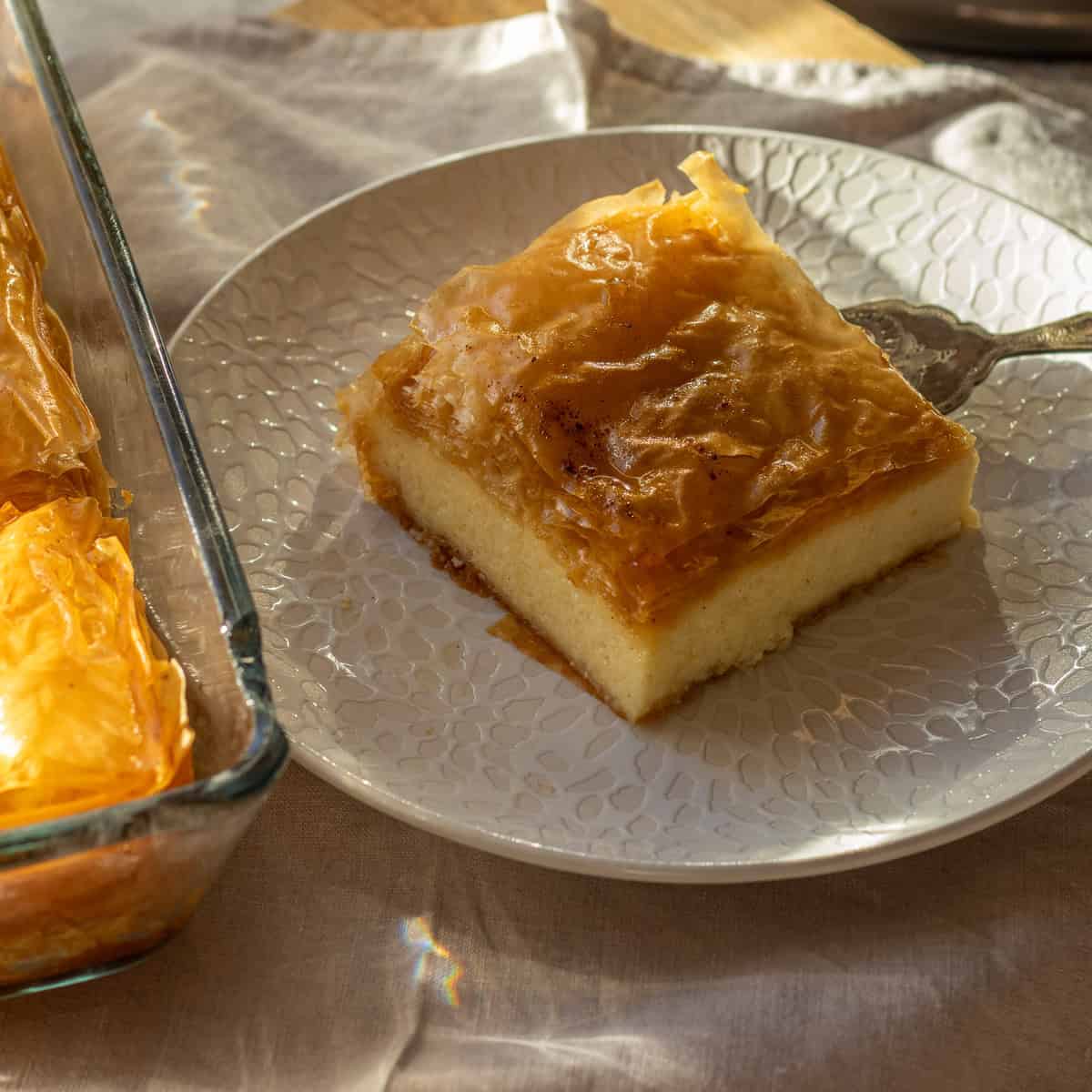
Once the rolls are out of the oven, leave them for 5 minutes, and then slowly pour the cooled syrup over the hot rolls, just like when making Galaktoboureko - Greek Dessert with Custard. You'll hear it sizzle as it goes in. The pastry has to be hot and the syrup cold: if both are hot the rolls go soggy, and if both are cold the syrup sits on top and never soaks in.

Just like when making Cold Baklava - Soguk Baklava with Milk, let them sit for a few hours, ideally overnight to fully absorb the syrup. Sprinkle on ground pistachio before serving.

Recipe Tips From the Chef
- If you have frozen filo pastries, you'll need to thaw them in the fridge overnight. Don't forget to bring them to room temperature before building baklava rolls.
- Once the packaging is opened, keep the filo pastries covered with a damp towel to avoid them drying.
- You can make the syrup up to 3 days in advance! Make sure it is at room temperature before slowly pouring it over the freshly baked hot baklava.
- Use clarified butter or ghee to avoid dark and burnt marks on top of the baklava rolls.
- Butter is key to achieving the signature crispiness of the filo layers. Be generous but even when brushing it on.
- Chop the pistachio nuts finely, without turning them into a paste or powder.
- Roll loosely. A tight roll has no air in it and bakes up hard, and the air gaps between the crinkles are what make it crisp.
- Don't overfill. Two tablespoons of nuts per roll is enough, and more than that tears the filo when you scrunch it.
- Leave the last inch (2 to 3 cm) of the sheet bare so the roll seals on itself instead of unraveling in the oven.
- Cut the rolls before they go in the oven. Baked filo shatters if you cut it afterwards.
- Let the baklava rolls rest after adding the syrup so they soak evenly.
What to Serve with Burma Baklava?
Burma Baklava is best served at room temperature, once the syrup has settled. Baklava rolls are traditionally served as a dessert, either on their own or accompanied by a scoop of Homemade Turkish Ice Cream - Maras Dondurma, or a dollop of Turkish Kaymak! They are a popular choice for special occasions such as weddings, holidays, and family gatherings.
In Turkish and Middle Eastern cultures, it is common to serve baklava rolls with a hot cup of Turkish Tea - Cay or Turkish Coffee. Sweet with bitter is the right match, and it's how most meals in Turkey end.
Storage and Make Ahead Instructions
Let the rolls cool completely before you cover them, then keep them in a tin or a loosely covered container at room temperature for up to 2 weeks. They're at their best in the first week. Never put them in the fridge, the cold turns the filo soft and the syrup cloudy.
To freeze, do it the way Turkish bakers do: bake the rolls, leave them without syrup, and freeze them in a container for up to 3 months. Warm them in the oven straight from the freezer and pour fresh syrup over them as soon as they come out. You can freeze unbaked rolls in the same way and bake them from frozen with 5 to 10 extra minutes. The syrup keeps for 3 days at room temperature, so make it ahead.
Recipe FAQs
Not as written, because I brush the filo with clarified butter. The filo itself is vegan, and in Turkey these are often made at home with olive oil instead of butter, so swap the butter for oil and they are. They come out a little less rich.
Nobody agrees, and Greeks, Turks and Persians all claim it. What is certain is that the version we know was perfected in the Ottoman palace kitchens at Topkapı, and Gaziantep baklava has had protected status in the EU since 2013. Rolled burma is a later twist on the layered original.
Walnuts are what most Turkish homes use, because they cost less. Pistachios are the Gaziantep bakery version and the one I make. Hazelnuts are the Black Sea choice, and almonds or pecans work if that is what you have. Use one nut rather than a mix, and chop it fine without grinding it to a paste.
No. A thin wooden dowel, the handle of a wooden spoon or two skewers held together all work. Anything much thicker than a finger makes the rolls too wide to scrunch.
Baked filo shatters when you cut it, so the pieces break into flakes instead of clean slices. Cut each roll into three before it goes in the oven, when the pastry is still soft.
Two causes. The rolls came out of the oven before they were properly browned, or the syrup went on at the wrong temperature. Bake them until they are deep gold all over, and pour cold syrup over hot pastry. Keeping them in the fridge softens them as well.
Related Recipes
For more syrup-soaked dessert recipes, why not try:


Did you make this recipe? Please let me know how it turned out! Leave a comment below and tag @cookingorgeous on Instagram and hashtag it #cookingorgeous.
I hope you enjoy the process of making this Burma Baklava as much as you enjoy eating it! 🙂
Want to Save This Recipe?
Enter your email & I'll send it to your inbox. Plus, get great new recipes from me every week!
By submitting this form, you consent to receive emails from Cooking Gorgeous

Burma Baklava
Ingredients
- 1 lbs phyllo pastry (16 sheets) (1 pack of 470 grams)
- ½ cup clarified butter
- ¼ cup vegetable oil
- 2 cups ground pistachio
For the Syrup
- 2 ½ cups water
- 2 ½ cups caster or granulated sugar
- lemon juice (few drops)
Instructions
Prepare the Syrup
- Start by making the syrup, as it needs time to cool completely before being poured over the baked rolls. Place the water and sugar in a pan and put on medium heat.
- Stir it until the sugar dissolves, bring the mixture to a boil, then reduce the heat and gently simmer for 15-20 minutes.
- Add a few drops of lemon juice, let it simmer for a few more minutes, and then remove the pan from heat. Let it cool down while preparing the filo sheets.
- Chop the nuts finely, either by hand or using a food processor. Set it aside.
Assemble the Baklava Rolls
- Preheat the oven to 175 °C - 350° F.
- Mix clarified butter and vegetable oil in a small bowl.
- Open the packaging of phyllo dough, lay it on a clean worktop, and keep it covered with a damp towel to prevent it from drying out.
- Place one sheet of phyllo dough on a clean working surface and drizzle a spoon of the butter mixture over it. Place another phyllo sheet on top and lightly drizzle it with butter too.
- Sprinkle on 2 tablespoons of ground pistachio over half of the buttered phyllo sheets, and spread it evenly.
- Place oklava (thin rolling pin) at the bottom of phyllo sheet as it shows in the picture, and roll it up.
- Using your hands, gently press the ends towards the middle, tuck them in and remove the rolling pin. Place it on your baking dish and repeat with the remaining phyllo sheets.
- Using a sharp knife, cut the each of the baklava rolls in three pieces. 16 pieces of phyllo sheets will give you 24 portions in total.
Bake the Baklava Rolls
- Brush the tops generously with more melted butter. Bake in a preheated oven for 30-40 minutes, or until golden and crisp.
- Once the rolls are out of the oven, leave them for 5 minutes, and then slowly pour the cooled syrup over them while they’re still hot. The syrup will soak into the rolls, ensuring every bite is moist and flavorful.
- Let them sit for a few hours, ideally overnight to fully absorb the syrup.
- Sprinkle on ground pistachio before serving with a dollop of Homemade Turkish Ice Cream - Maras Dondurma.
Video
Notes
- Thaw frozen filo in the fridge overnight and bring it to room temperature before you start. Keep the opened sheets under a damp towel.
- Use clarified butter or ghee mixed with a little oil, so there are no burnt milk solids on top.
- Chop the pistachios finely, but stop before they turn to a paste. Walnuts or hazelnuts work the same way.
- Roll loosely and don't overfill. Two tablespoons of nuts per roll, and the last inch (2 to 3 cm) of the sheet left bare so it seals.
- Cut each roll into three before baking. Baked filo shatters if you cut it afterwards.
- Bake until deep gold all over, then pour cold syrup over the hot rolls. If both are hot they go soggy, if both are cold the syrup doesn't soak in.
- Let them sit for a few hours, ideally overnight, before serving.
- The syrup can be made up to 3 days ahead and kept at room temperature.
- Store at room temperature in a tin for up to 2 weeks, never in the fridge. Freeze baked and unsyruped for up to 3 months, then reheat and pour fresh syrup over.
- For a vegan version swap the butter for olive oil.

Laila says
I made this for the Eid and everybody loved it! It was incredibly easy to make too, thank you for the detailed recipe!
Ayla Clulee says
So happy to hear that, Laila! Glad it was a hit and easy to make too.